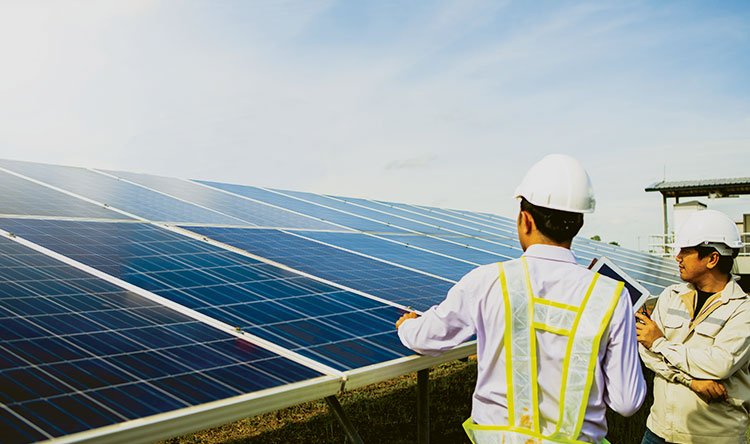

If you have ever wondered how a few blue or black panels on a roof can run your fans, fridge and TV, this guide is for you. Rooftop solar is not complicated, and once you understand the basic parts, every quotation you receive will make far more sense.
Step 1: Panels turn sunlight into DC electricity
Each solar panel is made of many small photovoltaic (PV) cells, usually made of silicon. When sunlight hits these cells, it knocks electrons loose and creates a flow of electricity. This electricity is direct current (DC) — the same type of power a battery gives.
A typical modern panel used in Indian homes is rated between 540 and 590 watts. Several panels are connected together in a "string" to build a system of 2 kW, 3 kW, 5 kW or more.
Step 2: The inverter converts DC to AC
Your home appliances run on alternating current (AC). The inverter is the brain of the system. It converts the DC from the panels into AC at the right voltage and frequency, and it also:
- Tracks the best operating point of the panels through the day (called MPPT)
- Shows how many units (kWh) you have generated
- Shuts down automatically if the grid fails, so line workers stay safe
Step 3: Your home uses solar power first
The AC power from the inverter goes into your main distribution board. Whatever your home is consuming at that moment is supplied by solar first. If solar is producing 2.5 kW and your home is using only 1 kW, the extra 1.5 kW does not go to waste.
Step 4: Extra power goes to the grid through a net meter
In an on-grid system, the surplus electricity flows into the electricity company's grid through a bi-directional (net) meter. This meter records both the units you take from the grid and the units you send back. At the end of the billing cycle, you pay only for the difference, as per the rules of your electricity supply company (ESCOM) and the state regulator.
At night, when panels produce nothing, your home simply takes power from the grid as usual.
What about batteries?
Most homes in cities choose on-grid systems without batteries because the grid acts like a free "storage". If your area has frequent power cuts, a hybrid system with a battery can keep essential loads running. We explain the differences in detail in our guide on on-grid, off-grid and hybrid systems.
How much power will it generate?
In Karnataka, a well-installed 1 kW system typically generates around 4 to 4.5 units per day on average, depending on shade, panel direction, dust and season. So a 3 kW system can produce roughly 360–400 units per month — enough for many middle-class homes.
The bottom line
Panels capture sunlight, the inverter converts it, your home uses it, and the net meter takes care of the extra. It is a quiet, simple system with almost no moving parts — which is why it lasts 25 years or more with basic care.
Want to know what size system your roof and bill need? Our team in Kalaburagi offers a free site visit and an honest estimate.